Showing posts with label Art History. Show all posts

Friday, August 31, 2012

The Sixty-Eight Rooms by Marianne Malone

Okay, I'm pretty sure Allison is going to keel over from surprise when she sees that I FINALLY posted something to this blog! I told her I would eventually get around to it. And look, I did. :-)

A mom of a good friend of my oldest daughter contacted me at the beginning of the summer and asked if we might be interested in doing a book club with the girls this summer. I wholeheartedly replied YES! And it turns out her younger daughter (the same age as my younger daughter was participating as well). At first, I was thinking the books we picked would be books our incoming third graders would read themselves. But once she sent the book choices to me, it was apparent the books would be above level and we would read aloud to them. This actually worked to our advantage because the younger girls (incoming first graders) would hear the story as well and could participate easily. The first book we read was ELLA ENCHANTED (I will fully review this book in a separate post). And the second book we read was The Sixty-Eight Rooms by Marianne Malone.

Having the museum background that I have, and having visited the Art Institute of Chicago probably close to 20 times in my life, I suggested this book for the girls to read. Mostly, because I was DYING to read it! I believe the first time I visited the Art Institute I was probably about 12 or so--about the main character's age--and I remember LOVING the Thorne Rooms. And ironically, I don't remember the last time I looked at them when I visited the museum.

In the story, two sixth graders, Ruthie and Jack visit the Art Institute on a field trip and happen to meet a nice museum guard while visiting Gallery 11, the Thorne rooms. The Thorne rooms are 68 rooms created by Mrs. James Ward Thorne between 1932 and 1940. Ruthie is fascinated by the rooms and wishes she could shrink down and visit them personally. Not long after she thinks this, she and Jack find a mysterious key laying on the floor of a corridor while the guard is giving them a tour. She magically shrinks down and is able to enter the rooms! This begins a grand adventure where Ruthie and Jack visit pre-revolutionary France and Topsfield, Massachusetts during the Salem Witch trials. They are able to meet real characters from history on their journey and discover part of the truth behind the key and its magical tie to the Thorne rooms.

This was an absolutely FANTASTIC read for both my first and third graders. They were completely engaged the entire story. They wanted to keep reading to hear more. We got MINIATURE ROOMS: THE THORNE ROOMS OF THE ART INSTITUTE OF CHICAGO by Fannia Weingartner from the library. That way when Ruthie and Jack visited various rooms we could look through the library book and see exactly what they were talking about. Now, I'm sure you can google images of the rooms as well, but there is something about NOT using a computer to see them that appeals to me. 
All the girls in the book club as well as the moms LOVED THE SIXTY-EIGHT ROOMS. It created great discussion about foreshadowing and character development. Also, history, art and museums. I cannot recommend this book highly enough! And although it is very nicely wrapped up in the end, there are several things unanswered. And in this case, it is fabulous that there are more answers to be found because the author turned this into a series! We can't wait to read STEALING MAGIC, the second book in the series.

Anyone who loved the Magic Tree house books and the way they tie in history in fiction will love to read this as an older child. And I guarantee you will be planning a trip to the Art Institute of Chicago to see the rooms in person! We're heading there over Christmas break this year!

Source Disclosure: We purchased this book for our personal library.

Thursday, June 23, 2011

Picture Book Thursday: Art Project Book Reviews

And now for something slightly different from my normal Picture Book Thursday post (and some shameless promotion besides).....I have started an art project blog to keep track of the projects I do with my girls during the summer months. I may not be able to read a ton of fiction these days or update the book blog often, but I felt like I could commit to updating an art blog weekly for the summer months. :-)

I plan out lesson plans each week by picking an artist, an artistic style, or a theme. I show my kids images of famous paintings that go along with the subject and then they work on an art project related to that.

We also have been making weekly (sometimes even twice a week) trips to the library this summer. And my oldest daughter has been into borrowing "How to draw...." books. So I've visited the 700-750 range in the nonfiction section of the library often. And I've found some GREAT books relating to art and kids. I decided I was going to put up a few reviews of these books on the art blog. Since they were BOOK REVIEWS, I figured why not cross post on the book blog as well. I'm sure there are some mom book bloggers out there who might be interested too! :-)

I found this book, Art in Action(1) by Maja Pitamic this week at the library as well as its counterpart Art in Action(2). Oh my, these are FANTASTIC books relating art and kids' art projects! I will be purchasing them. They break down into chapters by a certain theme like "Color", "Shape", or "Portraits". And then an artwork is profiled that fits within the theme. The artwork page shares interesting yet simple information about the artist or style and then the following pages depict project ideas.

Below shows the artist page for Henri Rousseau's jungle image: Surprised. We actually did a project related to this painting last year. You can see our project here. This page in Art in Action shows a fun collage you could do with the kids' handprints.


The images above show what the artwork page in the book looks like and the finished project.
In the "Nature" chapter of the book (below), you can see an image of Jacopo Zucci's Pergola with Birds and then create the following projects:


You can see from the images I took that the projects come with very visual instructions, also a supply list and most of them are very easy to do. The bird rug project could be applied to other imaginative play as well. Your kids could make rugs for their dolls. My daughter has a kitchen setup for her American Girl doll, this would be a perfect thing for her to make for that too.

What really impresses me about these books are the ease of the projects, the relatively "normal" supplies that can be found around most households easily, and the creativity behind the project ideas. These are things I have not really seen before (at least not all in one book). And I love that I'm interested in more than one project in a book. Sometimes, I find books where only one or two things appeal to me.

This last one is a Cezanne painting and a 3-dimensional box sculpture.

I would love for any of you to head over to Holly's Arts and Crafts Corner and become a follower! I have a few more books I may review of this sort. Please leave a comment and let me know if you might like to see more reviews of this sort here.

Tuesday, February 09, 2010

The Gardner Heist by Ulrich Boser

I wanted to read this book last year when I was participating in the Art History Reading Challenge. I first heard of the Gardner Heist ten years ago when I was in grad school for Museum Science. And then again when I took an online Forensics course through Barnes and Noble several years ago. They had this case as one of the examples to discuss how things could have been handled differently by the authorities.

For those who aren't familiar, nearly 20 years ago (the anniversary is actually March 18th this year) two men dressed as police officers banged on the security door of the Gardner Museum in Boston. The guards let the two men in and were tied up in the utility room while the men went about stealing (ripping/cutting paintings out of their frames and leaving the empty frames on the wall) about a dozen artworks from the museum. And then they just disappeared into the night. The paintings have yet to resurface anywhere in auctions or the underground art world.

Boser's book very thoroughly traces the history of the investigation from renowned art investigator Harold Smith all the way through his own obsession with trying to crack the case. And amazingly enough, this case is still open today with only theories and speculation left as to what happened to the artwork.

I found this book a bit tedious to get through, while it is VERY thorough, I feel like maybe just a tad bit too thorough. There are sooo many names and places and Boser comes back to the some of the names in later chapters. It was a little difficult for me to keep track of everyone. However, it was very interesting too! Quite an inside look into the art theft world and just the criminal world in general. Some of the people Smith thought could be behind the theft were scary individuals. It's pretty surreal for a naive Midwestern girl like me to fathom the reality of the mob world and that the characters you see on television and movies do exist in the real world. I mean, you know people like that exist in the real world, but to see their personalities laid out in a nonfiction book, just incredible. I like my little bubble of goodness I live in. :-)

If you like investigative reports or are particularly interested in art theft, this would be a great book for you. Otherwise, I suggest moving on.
Source disclosure: Borrowed this from the library.

Thursday, April 30, 2009

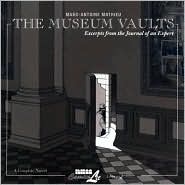
The Museum Vaults: Excerpts from the Journal of an Expert

I used this graphic novel by Marc-Antoine Mathieu as a quick entry for the Art History Reading Challenge. Yes, I do plan to actually read an adult fiction or nonfiction book for this challenge. But just haven't gotten there yet. :-)

I enjoyed the three other graphic novels I've read in the last year so I thought this would be a fun addition to my reading for this challenge. The basic storyline follows Monsieur Volumer, an expert in his field of indexing, cataloging, and evaluating museum collections as he travels through the Museum. He enters the Museum and begins to go through its holdings, making his way through each and every storage area, traveling deeper and deeper into the depths of the museum. This very short book (at 60 pages) is full of fun and sarcastic humor with regard to museums and the art world. For example, the first few pages discuss how the lower levels of a museum all look the same and you can get lost in the similar hallways, but that you eventually "end up getting used to it all." (page 8). Anyone who has ever worked in the basement of a standard museum will chuckle at this as yes, most museums have limestone, solid foundations, built to withstand all. And most are all painted exactly the same and seem to be a maze of hallways with access doors. Later in the book, fun is poked at "the archives service" or the mountains and mountains of paperwork found in a museum. And so it goes on from there.

The philosophy of art is also discussed throughout the book with regard to paintings and what truly is art. Are reproductions of art art within themselves? or just the original masterpiece? There is one section where a gentlemen is obviously referencing the Mona Lisa without really saying it. He discusses how the invention of the camera obscura really changed the way art was viewed. He said there were many copies of different paintings and the staff would change them out. He used the example of one painting of a woman in which they had many copies each with a different facial expression. He would change them out in the gallery periodically and people would be curious about her change of expression, never knowing that the painting had actually been changed. But someone took a photo of the painting where she is smiling slightly, and it ended up in an art book. He's had to leave that one up ever since. He claims it's a shame that no one will ever see the other paintings again. Obviously this has never happened, and its meant to be funny. I really got a kick out of how creative Mathieu was in getting his points across about the irony of art and the museum world.

Now, all that being said, the book was a bit jumpy, moving quickly from topic to topic, never expanding long on anything. And I'm not sure someone without a museum or art background would really enjoy this book at all. I give it four stars because I loved how accurate he was with his museum references, but I think this would be a 2.5 or a 3 out of five stars for someone without this kind of background. But then again, I'm not sure why someone would be drawn to a book like this if they weren't interested in art and museums. So that shouldn't really be a problem. :-)

Friday, March 06, 2009

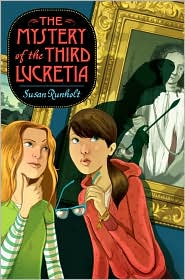
Mystery of the Third Lucretia by Susan Runholt

Oh dear, I’m sorry to say, but I hope you make it to the bottom of this post. I’m about to go on and on!

I picked this book up because it was sitting on the “New Arrivals” shelf in the children’s area of the Chanhassen library. How could I pass it up? It was a mystery, it was about art theft and the art involved was from the Baroque period (17th century). AND, I was familiar with the art topic of Lucretia! Seriously, I couldn’t get more excited. Plus, I could use this as my first book for the Art History Reading Challenge.

I’ll try not to go all art historian on you (I do have to go on a little bit though) and actually talk about the book in a minute. My focus for my art history major in college was Baroque art and I spent half my time studying the female artist Artemisia Gentileschi. I remembered one of the papers I wrote on her included her Lucretia so I just had to go Google the painting and look at it again before writing this. And because I’m a big dork and kept all my art history info from college, I even FOUND my paper and reread that part. You know what really TRULY amazes me? How easy do kids have it these days with the internet? I mean, yes, the internet existed when I was in school. But, not like today. I had to scour academic search engines to find information in journal articles and books on the topics I studied. There was no wikipedia. And there certainly was not an entire website devoted to Artemisia! I am feeling old and amazed by the information so readily available at our fingertips. Not to mention, how easy it would have been to study for an art history test if I could just bring up the images on my computer to look at! Instead of going to look at slides in the basement of the art building. Okay, I really will get to a BOOK review here. I just had to share why this book was calling to me to read it.

Susan Runholt’s book is a young adult mystery starring fourteen year old Kari and her best friend Lucas. The girls stumble across an art mystery when they encounter the same man in a gallery in the Minneapolis Institute of Art and The National Gallery in Britain. He appears to be copying famous Rembrandt paintings and the girls are intrigued to find out why. They start to spy on him and come up with clever ways of staying covert. After a third painting of Rembrandt’s Lucretia is “found” and donated to the Rijksmuseum, Kari’s mother realizes the girls really were on to something and attempts to help catch the forger. Danger, kidnapping and more ensue.

The book is written in first person from Kari’s point of view so we are treated to the inner workings a fourteen-year-old’s head. While many children’s and young adult books do not have the parents present, Runholt has very cleverly involved Kari’s mother to a point, but also provides good excuses for the mother to be busy in order for the girls to explore on their own. I think both mother and daughter are portrayed well here. From a younger person’s point of view, the mom seems rather cool and from a mother’s perspective the mom does react somewhat realistically to the situation at hand.

My only gripe would be that sometimes I felt like the writer let a little of her own voice into the story instead of sticking with Kari’s voice. Some of Kari’s thoughts and conclusions seemed a little mature for a fourteen-year old. And then again, other times, the voice seemed younger than fourteen to me. Actually, Kari’s voice seemed to mature over the course of the book. And maybe that’s what the author was going for since clearly being involved in a mystery, kidnapping and highly public art theft can mature a person.

Overall, this was a very fun adventure. I loved the art history references. I love the focus of the Lucretia story. Runholt has found a fantastic topic to write about for young women. Her message in the book is empowering and wonderful from the lessons both Kari and Lucas learn, to the portrayal of Lucas’ powerful grandmother ,and the evolution of Lucas’ mother from dizty socialite to devoted philanthropist. I so look forward to my daughters reading this book in the future. And I think this book would be a perfect addition to a mother/daughter book club list. It would be great to hear the reaction of both mothers and daughters to this book and their discussion of the mother/daughter relationships. This is a very PG-rated book. Where there might be swearing the girls use the word “Meep”. Even though its rated as young adult, other than the dangerous situations the girls get into, this book would be fine for younger than that. I’d say 10 and up.

Susan Runholt is a first-time author and the runner-up of the 2005 Debut Dagger Award by the Crime Writer’s Association of Great Britain. This was instrumental in getting this book published. Runholt also lives a stone’s throw away from me in St. Paul. She leaves the book opened for more mysteries from Kari and Lucas. In visiting the author’s website, I see her next book Rescuing Seneca Crane will be published this August! And she has already been asked to write a third book in the series.

I also came across the author's feelings about choosing her topic for the book and I just have to share them. “Mostly, THE MYSTERY OF THE THIRD LUCRETIA is meant to be just a fun book for kids--an exciting mystery that young readers can enjoy. But one of the things I was trying to do with the book was to write about ordinary kids who feel at home in museums and who respond very naturally and directly to art, the way my daughter did when she was their age. I really wanted to break down the barrier that somehow divides too many people, especially people in this country, from the beauty and power of art.” Go Susan!!

Thursday, January 08, 2009

The Art History Reading Challenge

I think I said in my year in review post that I don't join challenges because I don't want to commit to reading certain books; I like to go with the flow. Well, I did find one challenge that I think I can actually commit to and finish by the end of the year: The Art History Reading Challenge.

All you have to do is read six books within the year, fiction or nonfiction in any genre from historical fiction to graphic novels. And I already have five books here at home that would fit the bill. It's been way too long since I've engaged the art historian side of me. So this year I'll knock some books off my TBR stack and maybe, possibly finish a challenge!

Here's my list:
From my current TBR pile
1. Chasing Vermeer by Blue Balliet (YA Fiction)
2. The Lost Painting by Jonathan Harr (Nonfiction)
3. The Art Thief by (Fiction)
4. The Shadow Catcher by Wiggins (Historical Fiction)
5. Girl with a Pearl Earring by Tracy Chevalier (Historical Fiction)
Borrowed from the library
6. The Forger's Spell: A True Story of Vermeer, Nazis, and the Greatest Art Hoax of the Twentieth Century by Edward Dolnick (Nonfiction)

Others that I might swap for or just add to the list:
--The Gardner Heist: The True Story of the World's Largest Unsolved Art Theft by Ulrich Boser (Nonfiction)
--Glacial Period by Nicolas De Crecy (Graphic Novel)
--Museum Vaults: Excerpts from the Journal of an Expert by Marc-Antoine Mathieu (Graphic Novel)

Sunday, October 12, 2008

Masterpiece by Elise Broach

I won a signed copy of this book in a giveaway hosted by A Patchwork of Books. I was so excited to win. It sounded right up my alley. And I wasn't disappointed!

Masterpiece is a story of friendship mixed with a little art history and art theft. A lonely little boy named James, who is all but ignored by his mother and stepfather, discovers a little beetle named Marvin has a wonderful artistic gift. James receives a pen and ink drawing set for his birthday from his artist father. During the night, Marvin discovers the new set on James' desk. Curious, he starts dipping his front legs into the ink and creates a wonderful little drawing of the scene outside James' bedroom window. Delighted by the drawing, James discovers Marvin created it and an unlikely friendship is formed. The adults in James' life think he created the tiny, intricate drawing and are in awe of his new found talent. Upon a visit to the Metropolitan Museum of Art, James is asked to create a copy of a famous Albrecht Durer drawing. His copy is so close to the original that the museums curator develops a plan to try and catch an art thief. Throughout the story, Marvin and James work together first to create the drawings then to help solve the art mystery.

This book was a delight for me to read. It was fun to see art history woven into the story and I'm thrilled that this book might spark an interest in art history for children reading it. Though the friendship between James and Marvin is unlikely, it seems to work for this book. It is fun to read about Marvin's world and how the beetles view humans. I highly recommend this book to anyone who enjoys juvenile fiction. You won't be disappointed! And Kelly Murphy's pen and ink illustrations are so lovely. They fit right along with the story so well. Oh, this one was so fun and I look forward to reading more of Broach's books in the future.

Broach also wrote Shakespeare's Secret, which Allison reviewed here.

Tuesday, September 23, 2008

Back to the usual

It's time to get caught up on reviews! I'll start with the juvenile puzzle mystery type books. This is the companion post to this post right here., in which I reviewed The Mysterious Benedict Society and The Puzzling World of Winston Breen. I set out to read several juvenile novels in a similar vein, but the third was mis-printed, thus missing many pages, so I had to wait for the replacement. It sort of derailed my whole plan, but I've finished Chasing Vermeer, Shakespeare's Secret, and The Mysterious Edge of the Heroic World. The interesting thing to me about reading all five in a short-ish period of time is that I had lumped them all into one category, but they're really quite distinct from each other.

Chasing Vermeer by Blue Balliett: I've read that this is like DaVinci Code for children, but it's far better written, and there are elements of Magnolia as well. It takes place at University of Chicago Laboratory School, which was a lot of fun for me because I lived near there for three years, and Matt, who lived there as a child, actually went to Lab School. Petra and Calder, two U School students, are brought together by an eccentric elderly woman, mysterious letters, a troubled teacher, and the theft of a Vermeer painting by a thief who ostensibly has ideals. The crime has baffled the FBI--can two precocious children solve it using puzzles and coincidences? I enjoyed the highly improbable mystery and the unfolding coincidences. It takes a while for everything to come together, but Petra and Calder's budding friendship gives the reader something interesting while we wait. I would have loved this book as a child, with all the puzzles to figure out and a very complicated plot that doesn't underestimate its readers. The added element of learning art history is fantastic--like the world seized by interest in Vermeer in the book, children reading this will be sucked right into learning about Vermeer, and it could spark an interest in other mysterious artists.

Shakespeare's Secret by Elise Broach: This was similar to Chasing Vermeer, but the focus here is on never-popular, unassuming Hero Netherfield, named after the Much Ado About Nothing character by her Shakespeare scholar father, and her developing confidence as she grows into her name and begins to make friends. The plot is much more simple, even stripped-down compared to Vermeer, more a crossword puzzle than a Dan Brown potboiler. Hero's new house, she learns from her next-door neighbor, Mrs. Roth, has a mystery: a diamond that was supposedly stolen may still be hidden there. As her friendship with Mrs. Roth grows and she is drawn into the mystery, Hero begins to learn about Shakespeare and the mystery surrounding his identity (along with some history of the time period), while making friends with the popular Danny Cordova. The story is more plausible and understated the the slick-by-comparison Chasing Vermeer, and the characters are more developed, leading to a surprisingly touching conclusion. Like the art history in Chasing Vermeer, the literary history in Shakespeare's Secret is sure to lead at least some readers into further research.

The Mysterious Edge of the Heroic World by E. L. Konigsberg: I loved E. L. Konigsberg as a child. I checked all her books out of the library, and read From the Mixed-Up Files of Mrs. Basil E. Frankweiler a dozen times, not to mention Jennifer, Hecate, MacBeth, William McKinley, and Me, Elizabeth (Konigsberg does not shy away from the long titles), and more recently, I had loved The View From Saturday, so I was the most excited about this book, but it was the one in the group of five that I liked the least. Amedeo wants to distinguish himself by discovering something, anything, of significance. He ends up helping a classmate, William Wilcox (who HAS actually discovered something important), prepare eccentric neighbor Mrs. Zender's house for an estate sale. He finds a sketch signed by Modigliani, who was reviled in Nazi Germany. Coincidentally, his godfather is working on a Degenerate Art exhibit at his museum. It takes forever for everything to come together, and the writing seemed odd to me. Very stilted dialogue, almost stylized and theatrical, with odd repetitions. I didn't really sympathize with Amedeo and William the way I did in the other four juvenile mysteries I read because they didn't feel real and fleshed out. The sections from Peter's (the godfather) point-of-view seemed out of place in a children's book. Mrs. Zender was more pathetic than anything, and a most unsympathetic character. The history lessons with Nazi treatment of art were interesting, however. Maybe I just missed the point on this one.